
When IRS Appeals Rebuilds the Case: ERC, R&D, and the Unknown Documents in PAM

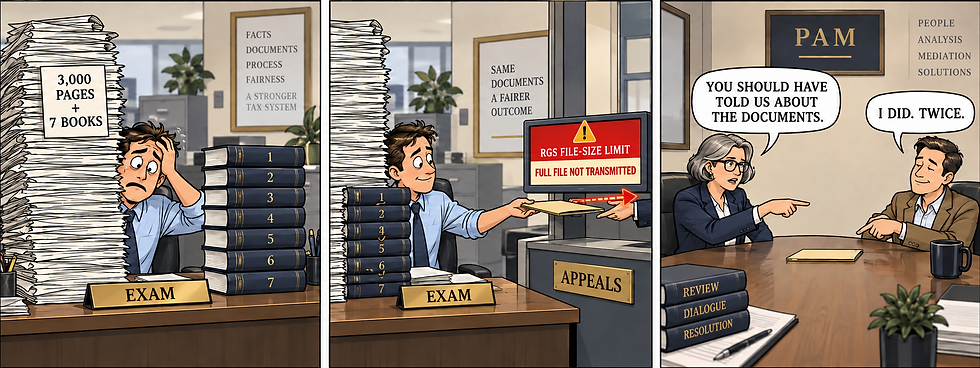
A taxpayer can deliver 3,000 pages and seven books to the IRS—and still arrive at Appeals carrying a file thin enough to make the evidence look imaginary.

That is not a hypothetical. It is the recurring administrative-record problem behind large Employee Retention Credit and research-credit cases: Examination receives the material, does not meaningfully analyze it, and forwards only part of the file. Appeals or the Appeals Team Case Leader then encounters a thin record. By the time the case reaches Post-Appeals Mediation, the response may be: “You should have told us about those documents.”
But the taxpayer did. Sometimes twice.
The right question is not merely whether the taxpayer bears the burden of proving the credit. Of course it does. The right question is who owns the hazard created when evidence actually delivered to the government was never evaluated, was not preserved in the file, or could not travel through the IRS’s own case-transfer system.
The problem is not always production. Sometimes it is transmission.
From my experience in Employment Tax Policy when I was a Director and involed in the scanning initiatives, the Report Generation Software system imposes a total file-size ceiling on what can travel with an electronic case. The public Internal Revenue Manual confirms that RGS supports the electronic case file from pre-audit through closure, but it does not publish the numerical ceiling.
In a document-heavy ERC or research-credit case, the practical result is obvious: the electronic file that reaches Appeals may be only a subset unless someone separately preserves and transfers the excess records. The technology explains how the gap can occur. It does not convert evidence the taxpayer previously supplied into evidence the taxpayer failed to produce.
That distinction matters. A missing document and an unsubmitted document are not the same fact.
RRA 98 and AJAC drew a line between Appeals and Examination
Congress directed the IRS to maintain an independent Appeals function in section 1001 of the IRS Restructuring and Reform Act of 1998. Congress later codified the Independent Office of Appeals and its mission in IRC § 7803(e): resolve federal tax controversies fairly and impartially, promote consistent application of the law, and enhance voluntary compliance.
The IRS’s Appeals Judicial Approach and Culture memorandum translated that independence into case-handling rules. Appeals is not supposed to inherit a half-developed case and quietly finish the audit. Examination develops facts and proposes adjustments. Appeals evaluates the disputed issues and litigation hazards.
The current Appeals case-receipt manual is unusually direct. A fully developed case should contain the pertinent evidence, well-documented facts, and an easy audit trail. When a case is underdeveloped but does not involve new information, Appeals generally should settle it by considering the factual hazards created by that underdevelopment. Missing required information can justify returning a case, and when a paperless case is returned the manual instructs Appeals to upload all taxpayer-provided records.
If Examination chose “the documents do not change my mind” instead of an analysis, that analytical gap is a government hazard—not proof that the taxpayer withheld the record.
A new theory is not always a new issue—but sometimes it becomes one
Appeals may consider a new legal theory supporting an existing adjustment. But the label does not control. IRM 8.6.1.7 asks whether the theory requires different evidence or is genuinely separate from the issue Examination raised. If different evidence is needed, the supposed “new theory” is functionally a new issue.
That is the hinge in an ERC case. Assume Examination focused on whether the employer identified qualifying governmental orders. It requested orders, gross-receipts material, payroll data, operational records, and employee information. The taxpayer produced roughly 3,000 pages. Examination then disallowed the credit with a conclusory statement that the production did not change its position—without explaining what it reviewed, what facts it found, or why those facts failed the test.
At Appeals, the government pivots to whether the orders caused a more-than-nominal partial suspension. Under Notice 2021-20, that inquiry can require facts about the affected portion of the business, operating hours, employee service hours, supplier disruption, remote-work capability, and the causal connection between an order and the operational effect.
If those facts are already in the 3,000-page production, Appeals may evaluate them. But it must evaluate the actual record—not an examiner’s unexplained conclusion. If the theory requires a fresh round of factual development because Examination never pursued it, Appeals is no longer merely weighing hazards. It is rebuilding the case Examination did not make.
The seven-book research-credit problem
The same problem appears in research-credit cases. In one matter, the taxpayer presented seven books of substantiation to Examination and again to Appeals. The administrative file later contained a sentence saying the materials had been reviewed and were not substantive. What it did not contain was an evaluation of the books: no identification of the projects examined, no mapping of evidence to the statutory tests, no explanation of what was missing, and no record showing how the conclusion was reached.
Worse, the Appeals team did not know Examination had received the books and did not itself receive them. The sentence traveled. The evidence did not.
That is not a record review. It is a conclusion laundering itself through the file.
The requirement that a notice describe the basis for the tax due is reflected in IRC § 7522. The same basic principle should animate the administrative record: a conclusion that the evidence is “not substantive” cannot substitute for an explanation of what the IRS reviewed and why it failed.
What PAM is supposed to do
Post-Appeals Mediation is an extension of the Appeals process after ordinary Appeals negotiations have failed. Under IRM 8.26.5, the mediator facilitates negotiations but has no settlement authority. PAM works with the issues and factual record that remain after Appeals—not as a second examination and not as a cure for a case file nobody verified.
The mechanics are straightforward. The parties identify the disputed issues, exchange short written summaries, sign a mediation agreement, participate in a joint session and caucuses, and attempt to reach a settlement. If they agree, the settlement is documented. If they do not, the ordinary Appeals closing process continues.
Summaries and exhibits are useful when they organize an agreed, mature record. They become dangerous when they replace the record. A five-page mediation summary cannot reveal that 3,000 pages or seven books never reached the decision-makers. And because PAM generally does not permit the parties to introduce genuinely new facts or arguments during the session, the taxpayer can be trapped: the IRS treats old evidence as new because the IRS lost the custody trail.
“You should have provided it anyway” misses the point
The government’s best response is predictable: the taxpayer bears the burden of proving entitlement to the credit, so any missing information is not a litigation hazard for the government.
That argument is right only when the taxpayer never supplied the proof. It does not answer a case in which the taxpayer can establish delivery and the IRS failed to preserve, transmit, or analyze what it received.
Burden of proof and institutional custody are different questions. The taxpayer should be prepared to prove the credit again in court. But Appeals’ job is to evaluate hazards based on the actual administrative history. A trial court may hear the witnesses and review the 3,000 pages or seven books. That possibility creates risk for the government when the Examination file contains no meaningful analysis and the Appeals file is incomplete.
Nor should Appeals obtain an informational advantage through prohibited back-channel development. The Appeals ex parte communication rules protect independence by limiting substantive communications with originating functions outside the taxpayer’s participation. File reconstruction should be transparent: identify what is missing, where it was last known to exist, what is being replaced, and whether any genuinely new facts are being offered.
A practitioner’s playbook for a thin-file case
Build an evidence inventory before the case leaves Examination. List every production by date, delivery method, Bates range, file name, page count, and receipt confirmation.
Separate proof of delivery from the merits. The first shows what the IRS possessed; the second shows why the credit is allowable.
Ask Appeals to identify the record it actually received. Do not assume the electronic case file contains every attachment, portal upload, compressed folder, or physical binder.
State expressly that a replacement copy is not new evidence. It is a duplicate of evidence previously delivered, supplied to repair a custody or transmission gap.
Make record completeness a threshold PAM issue. Before discussing settlement percentages, obtain agreement on which documents the mediator and Appeals officer possess.
Classify every proposed Appeals pivot. Is it an alternative legal theory based on established facts, or does it require different evidence and new factual development?
Force analysis, not adjectives. Ask which documents were reviewed, which facts were accepted, which legal element failed, and where that reasoning appears in the administrative record.
Tie the remedy to the defect. An underdeveloped government case supports factual hazards; a missing case file may require reconstruction or a return; a genuinely new issue should not be raised merely to strengthen the government’s position.
The bottom line
Appeals can analyze the case that arrived. It should not pretend that a thin file proves a thin production.
RRA 98, the AJAC project, and Appeals’ own manual all preserve the same institutional line: Examination develops the government’s case; Appeals independently evaluates it. RGS limitations and incomplete file transfers may explain why that line becomes blurred. They do not erase it.
When the taxpayer produced 3,000 pages, or seven books, and the IRS response was “they do not change my mind” without an analysis, the hazard belongs with the government function that failed to develop and preserve the record. PAM should expose that defect and help the parties value it—not blame the taxpayer for the IRS’s unknown documents.
Contact us if an ERC, research-credit, Appeals, or PAM matter has reached the stage where the file history matters as much as the merits. We help controversy professionals reconstruct the record, identify the real hazards, and prepare the case for a meaningful mediation.
Heath Harwell Vo, JD, CPA Independent Mediator - IRS Post-Appeals Mediation
We left the IRS. You're welcome.
This article is for general informational purposes only and is not legal or tax advice. Results depend on the facts and procedural posture of each case.


Comments